
EQoach AI Arena
Gamifying AI-powered communication skills learning experience
TIMELINE
Sep - Dec 2024
ORG
Microsoft AI
Asia-Pacific R&D Group
MY ROLE
Product Design Intern
TEAM
2 Product Managers
6 Software Engineers
1 LLM Researcher
1 Senior Leadership
CHALLENGE
How to create a safe and fun space where early professionals can practice difficult workplace conversations, receive honest feedback, and improve their communication skills, without risking real relationships?
SOLUTION
EQoach is a gamified learning app that helps users improve their communication skills through personalized learning paths and AI-generated social scenarios.
FINAL DESIGN
I initiated the design and validation of the core learning feature: an AI-powered role play experience where users could practice difficult workplace conversations, get feedback, and grow.
01
02
03
IMPACT
Launched in Microsoft Global Hackathon 2024, got recognition from senior leadership, and was awarded and selected for further development and integration in Copilot to drive user growth & engagement
⛳️
92%
Task Completion Rate
👍️
86%
Net Promoter Score (NPS)
🏆️
Awarded
Global Hackathon 2024
BACKGROUND
Rethinking how people learn communication skills
When I joined, the team aimed to let users “practice communication like a game.” My goal was to leverage explore how to increase user engagement in this experience.
The vision was broad, but the timeline was tight. I had 3 weeks to research, design and hand off the entire feature before a showcase event, where the team would gather feedback for the final launch for the Global Hackathon.
WHY IT MATTERS
Communication skills are universal, and still hard to learn!
Before diving into design, I worked with PMs on secondary research to understand the problem space. We found that people often face social dilemmas and are eager to improve their communication skills in daily life, especially for young professionals navigating workplace interactions.
💰
$93.6B
Global market share by 2033
📈
12%
Annual growth in the US
📈
10.6%
Annual growth in Europe

LinkedIn User
Gen Z don’t have communication skills, they lack emotional intelligence and will struggle to engage with peers and stakeholders in working…
LinkedIn User
Why are so many young employees intimidated by top management?

Reddit User
I’m one of the more junior members on my 5-engineer team… working through a difficult situation in my workplace and looking for outside perspectives…
USER PROBLEM
However, people did not get enough help from traditional learning methods…
We also conducted a survey & follow-up interviews which revealed that 92.9% of respondents who have tried to improve their communication skills found the results not very helpful.
🧐️
Most learners rely on passive learning: Reading books, listening to podcasts, browsing online posts.
🤯️
Many say books or media help gather “talking ideas,” but real challenge is practicing those in real situations.
😩️
Traditional training feels like homework, leading to poor completion rates.
OPPORTUNITY
How might we helps early professionals actively practice & grow communication skills in daily scenarios?
🗣️️
Learning by practicing
Users actively engage in realistic communication challenges with feedback.
🎮
Immersive & intuitive
Experiences are gamified and feel natural, not like traditional “reading.”
🪄️
AI‑powered scalability
Personalization and scenario generation adapt to each user’s needs and scale effortlessly.
MVP STRATEGY
Designing a practice-first interaction model
Working with PMs, we came up with a practice-first interaction loop that breaks away from the traditional linear process.

Traditional linear learning process

Practice-first learning process
The system features LLMs generated, scenario based challenges with varying difficulty levels. In each challenge, users are given tasks in real workplace situations, role play with AI characters to achieve tasks, receive instant feedback, learn from analytical reports, and unlock new challenges as they progress.

DESIGN
Structuring the core building blocks in each challenge
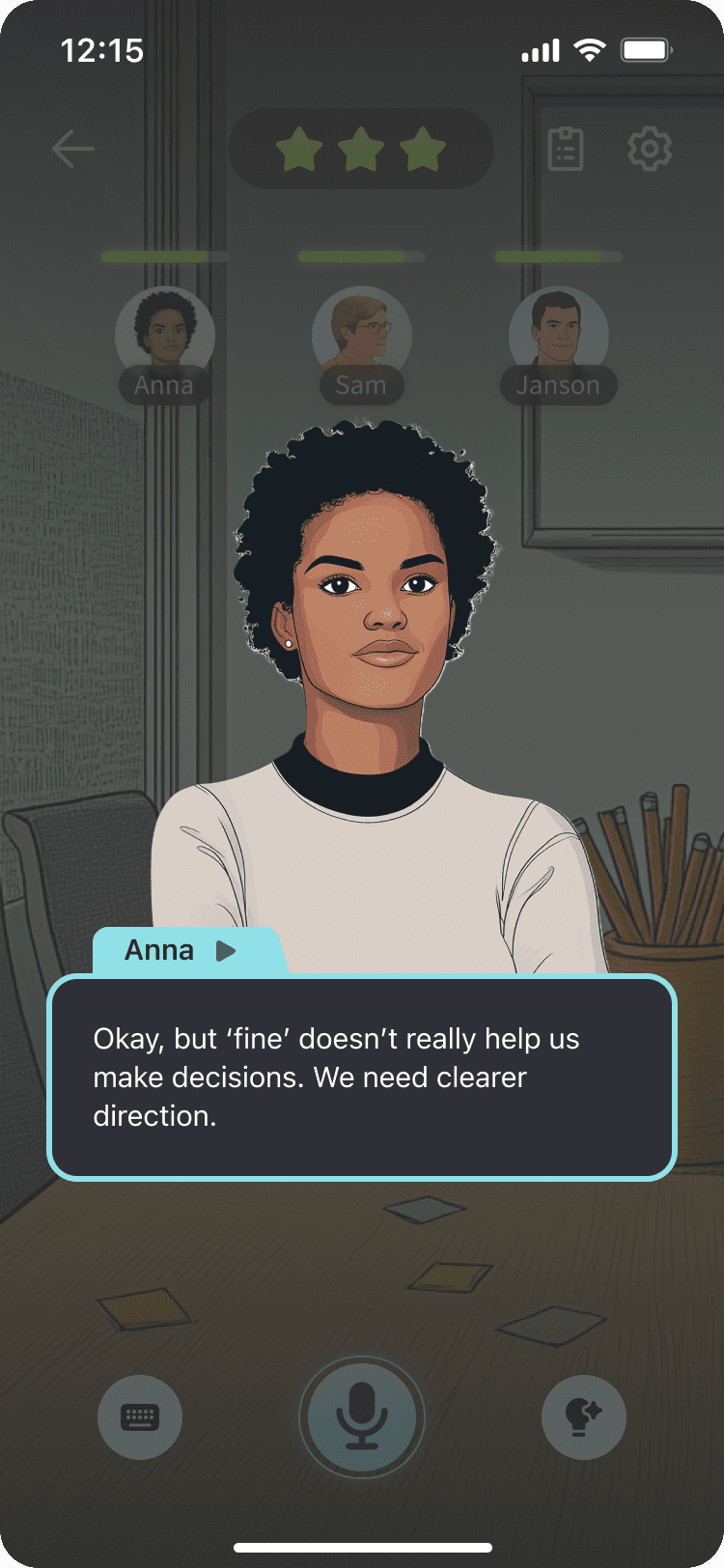
To create an immersive and fun experience, I highlighted AI characters’ feedback in each challenge. I also explored layouts that could make content easy to scale with LLMs. The final structure included 5 sections, designed to support the evolving content in each game challenge.
NPC action/
conversation context
User action:
reply by speaking
reply by typing
use a hint card
LLM-generated background
NPC mood indicator
Overall score indicator of each challenge
EARLY VALIDATION
Identify opportunities of improvement
We launched the early prototype and presented it at an internal showcase event. During the event, I led usability testing to validate feature functionality and prompt effectiveness. The concept was well received, but the interaction flow still needed improvement.


ITERATION
Redesigning for natural, AI-native conversations


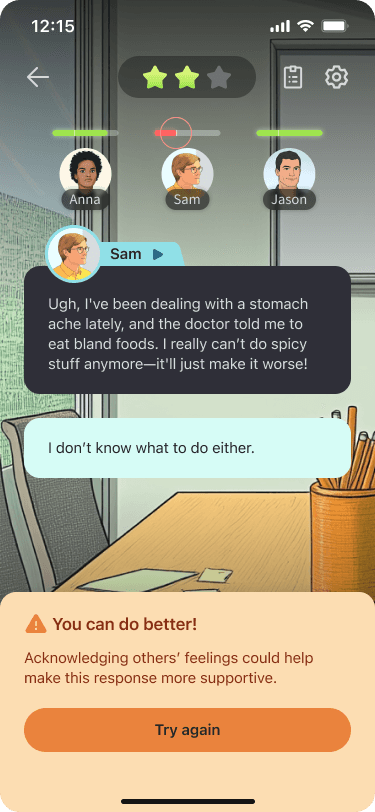


Analyze user input

Generate next dialogue
DESIGN FOR AI AT SCALE
Keeping visual consistency across AI-generated content
As we started from just several scenarios but aimed for a scalable future, a new challenge emerged: AI could generate backgrounds, character headshots and theme colors, but consistency was unpredictable.
To solve this, I separated the background and character generation. I worked closely with PMs and engineers, experimenting with prompts to ensure each image matched the game’s style. I also defined specs for a stable, customized color palette for each challenge.

WHAT DOES FUTURE SUCCESS LOOK LIKE
The success in user engagement and effective learning can be measured by…
Scenario Completion Rate
User Retention Rate
Time on Task
Net Promoter Score
Performance Accuracy
REFLECTION
🎨
AI can be treated as a design material
This project is a brand new experience since I learnt LLMs allowed interaction patterns that were impossible with traditional software. The key for designing for AI was to design clear guardrails while letting AI handle content variation.
🧐
Identify design problem and AI content problem
During usability testing, I realized the importance of separate design issues, technical bugs, and AI content inconsistencies. All caused friction for users, but I collaborated with cross-functional teams to prioritize the most urgent problems and focus on areas where design could make the biggest impact.
